When you’re sourcing materials for a project, whether it’s for large-scale furniture manufacturing or detailed interior trim work, every choice matters. The decision between using Medium-Density Fiberboard (MDF) or solid wood for baseboards and trim is a critical one that impacts cost, aesthetics, and long-term durability. As someone who has been manufacturing wood-based panels for over a decade, I’ve seen firsthand how the right material can make or break a project’s success. This article is your comprehensive guide, designed to cut through the noise and give you the practical, factory-floor insights you need to make a confident and profitable decision. We’ll explore the real differences between MDF and wood, from raw material to finished product, so you can choose the best option for your specific needs.
What Exactly Is MDF and Why Is It So Popular for Baseboards?
Let’s start with the basics. MDF, which stands for Medium-Density Fiberboard, is an engineered wood product. In our factories, we create it by breaking down hardwood and softwood residuals into fine wood fibers. We then combine these fibers with wax and a resin binder and form them into panels by applying high temperature and pressure. The result is a dense, smooth, and incredibly consistent panel that lacks the knots, grain, or voids you find in solid wood. This uniformity is a major reason why MDF has become a go-to building material for applications requiring a flawless finish.
The popularity of MDF for baseboard and trim comes down to three key factors: consistency, smoothness, and workability. Unlike natural wood, which can have unpredictable grain patterns that affect cutting and painting, every piece of MDF is identical. This means you get clean cuts with no splintering or tear-out, making the cutting and installation process much faster and more efficient. The surface of MDF is exceptionally smooth, providing a perfect canvas for paint. If you’re producing painted baseboards, you won’t find a better material for achieving a glass-like finish. This is a significant advantage over many wood species that require extensive sanding and a thick coat of prime to hide the grain.
From a manufacturer’s perspective, like my own, we can control the density and quality of MDF with incredible precision. We can produce boards that meet specific standards, such as CARB P2 for low formaldehyde emissions, which is a major concern for clients in the USA and Europe. This level of quality control is simply not possible with a natural wood source. This reliability is why so many furniture manufacturers, cabinet makers, and construction companies have come to rely on MDF for non-structural components like baseboards, casing, and decorative molding. It’s a product engineered for perfection.
Is MDF or Wood a Better Choice for Your Baseboard and Trim?
This is the central question for many procurement officers like Mark. The honest answer is: it depends entirely on the application, budget, and desired finish. There isn’t a single "better" material, but there is a "better fit" for your project. To make an informed decision, it’s helpful to compare them side-by-side. The great debate of MDF or wood is less about which is superior overall and more about which excels in specific categories.
Here’s a breakdown to help you decide between MDF and wood:
| Feature | MDF (Medium-Density Fiberboard) | Solid Wood (e.g., Pine, Poplar) |
|---|---|---|
| Cost | Lower cost, more budget-friendly. | Higher cost, especially for premium hardwoods. |
| Surface Finish | Perfectly smooth, no grain. Ideal for painting. | Natural grain. Can be painted or stained. |
| Consistency | Uniform density and size. No knots or voids. | Natural variations, knots, and imperfections. |
| Durability | High density resists dents, but can chip on edges. | Varies by species. Softwood dents easily. |
| Moisture Resistance | Susceptible to moisture; swells if not sealed. | Naturally more water-resistant, but can still warp. |
| Flexibility | Can be manufactured in flexible varieties for curved walls. | Less flexible; requires special techniques for curves. |
| Installation | Easy to cut without splintering. Heavier than wood. | Can splinter when cut. Lighter and easier to handle. |
| Environmental | Made from recycled wood fibers. | A renewable resource, but sourcing can be a concern. |
For projects where the trim and baseboard will be painted, MDF is often the superior choice. Its flawless surface means you can achieve a professional, high-end look with less prep work. You don’t have to worry about wood grain showing through the paint or knots bleeding through the prime coat over time. However, if the goal is to have a stained finish that showcases the look of natural wood, then solid wood is the only option. No amount of finishing can replicate the natural beauty of a wood grain. This is a fundamental difference that often makes the decision for you.
What Are the Real Cost Savings When Using MDF Baseboards?
When managing a budget for a large construction or manufacturing project, material costs are paramount. This is where MDF truly shines. The cost savings when you opt for MDF over solid wood baseboards can be substantial, often ranging from 30% to 50% per linear feet. This isn’t a small difference, especially when you’re purchasing thousands of feet for a multi-unit residential building or a large furniture production run. The lower cost of MDF stems directly from its manufacturing process. We use recycled wood fibers, which are less expensive than harvesting and milling whole lumber.
The savings extend beyond the initial purchase price. Think about labor costs. Because MDF cuts so cleanly and has a perfectly smooth surface, it requires less time for preparation and finishing. You don’t need to spend hours sanding down rough grain or filling knots. Most MDF trim comes pre-primed, saving your team a crucial step in the painting process. When you add up the reduced material cost and the savings in labor hours, the financial argument for using mdf baseboards in many applications becomes very compelling.
However, it’s important to approach this as a value proposition, not just a race to the bottom on price. As a procurement officer, you know that the cheapest option isn’t always the best. A low-quality MDF might save you a few cents per foot, but it could be less durable over time or have an inconsistent core, leading to problems during installation. The key is to find a supplier who offers a high-quality, durable MDF at a competitive price. This gives you the best of both worlds: a cost-effective solution that doesn’t compromise the integrity of the final product.
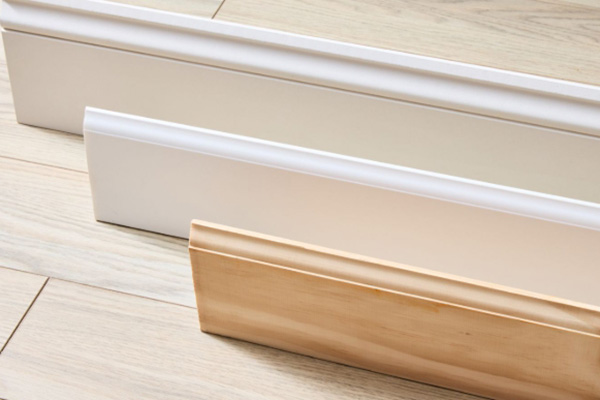
How Does MDF Hold Up in High-Traffic and High-Moisture Areas?
This is a critical concern, and one I discuss frequently with clients. The durability of MDF is a nuanced topic. In terms of resisting dents from impacts—say, from a vacuum cleaner or moving furniture—high-density MDF actually performs very well, often better than softwood like pine. Its dense, compacted structure is quite resilient. For this reason, it’s an excellent choice for most living rooms, bedrooms, and hallways. In these general high-traffic areas, MDF baseboards will look great for years.
The big caveat, however, is moisture. Standard MDF is like a sponge; if it gets wet, it will swell and lose its structural integrity. The fibers will expand, and the board will essentially crumble. This is why standard MDF is not recommended for areas with high humidity or the potential for direct water contact, such as a bathroom or basement. Once water damage occurs, the deterioration is irreversible, and the board must be replaced. This is the single biggest weakness of the material.
That said, the industry has evolved. We now manufacture moisture-resistant (MR) MDF. This type of MDF is made with a special resin that provides significantly better protection against humidity and occasional splashes. While it’s still not completely waterproof, MR MDF is a viable option for kitchens and bathrooms when installed correctly. The key is to ensure it is thoroughly sealed on all sides—including the back and cut ends—with a high-quality, water based primer and paint. Taking this extra step creates a protective barrier that prevents moisture from penetrating the core of the fiberboard.
Can You Achieve a High-End Look with MDF Casing and Molding?
Absolutely. There’s a common misconception that MDF is a "cheap" material that results in a "cheap" look. This couldn’t be further from the truth. In the world of high-end interior design, especially for modern and transitional styles, a smooth, flawless finish is often more desirable than a rustic wood grain. MDF is the ideal material for achieving this sophisticated, seamless aesthetic for your window and door casings.
The secret to a premium look with MDF lies in two areas: the profile and the finish. MDF can be milled into incredibly intricate and sharp profiles for molding and casing, just like wood. Because it has no grain, the details of the design are often crisper and more defined than what you might get with a softwood like poplar or pine. When you’re picking out trim, you’ll find that MDF offers a vast array of styles, from simple and modern to ornate and traditional.
The second, and most important, factor is the paint job. A high-quality painted trim can elevate any space. With MDF, you have the perfect substrate. After installation, any nail holes or seams are filled, the surface is lightly sanded, and then it’s ready for its final coats of paint. A professionally applied lacquer or semi-gloss paint on MDF baseboards and doors and windows casings creates a durable, elegant finish that looks anything but cheap. The one thing about mdf that designers love is its ability to disappear into the wall, creating clean lines and allowing other design elements in the room to take center stage.
What’s the Best Way to Install and Finish MDF Baseboards?
Proper installation and finishing are crucial for ensuring the longevity and appearance of your MDF baseboards. While installing baseboards made from MDF is straightforward, a few best practices can make a huge difference. First, let the MDF acclimate to the room’s temperature and humidity for at least 24-48 hours before installation. This helps prevent issues with expansion or shrinkage after it’s on the wall. When cutting, use a sharp, high-tooth count blade to get the cleanest edges possible. Although MDF is less prone to chipping than particle board, a sharp blade ensures perfection.
For fastening, use a pneumatic nail gun with finish nails. Drive the nails into the wall studs for a secure hold. Because MDF is denser than most woods, it’s important to set the nail gun depth correctly to avoid under-driving or over-driving the nails. If you’re joining two pieces on a long wall, use a scarf joint (a 45-degree angled cut) rather than a butt joint. This creates a much less noticeable seam once it’s filled and painted.
Finishing is where you create that professional look.
- Fill: Use a high-quality wood filler or spackle for all nail holes and seams. Overfill slightly, as it will shrink as it dries.
- Sand: Once dry, sand the filler smooth with fine-grit sandpaper (220-grit is ideal). Be careful not to sand through the factory-applied prime coat on the face of the board.
- Prime: This is a step many people skip, but it’s essential. Even if your MDF is pre-primed, you must prime all the cut ends and any sanded areas. This seals the porous fibers and prevents them from soaking up the paint, which can cause the material to swell. An oil-based or shellac-based primer is often recommended for the cut ends to provide the best possible seal against moisture.
- Paint: Apply at least two top coats of high-quality paint. Using a sprayer will give you the smoothest finish, but a good quality brush and roller can also yield excellent results.
Are There Different Qualities of MDF I Should Know About?
Yes, and this is a critical point for any procurement professional. Not all MDF is created equal. As a manufacturer, I can tell you that the quality of a raw plain MDF board can vary significantly based on the raw materials and manufacturing process. The primary differentiators are density, the type of resin used, and the grade of wood fiber.
There are generally three densities:
- Light-Density Fiberboard (LDF): Less common, lighter, and not as strong. Not typically used for applications requiring durability.
- Standard Medium-Density Fiberboard (MDF): The most common type, suitable for a wide range of applications including furniture, cabinets, and most trim work.
- High-Density Fiberboard (HDF): Denser, heavier, and more durable. It’s often used for laminate flooring and applications requiring superior impact resistance.
Beyond density, you have specialized types like the Moisture-Resistant (MR) MDF we discussed earlier, and Fire-Retardant (FR) MDF. Another key factor is the formaldehyde emission level. In our factory, we produce MDF that complies with E1, E0, and CARB P2 standards, which have very strict limits on formaldehyde. For projects in the USA and Europe, sourcing MDF that meets these certifications is non-negotiable. When you’re vetting suppliers, always ask for documentation proving compliance. A lower-quality MDF might use cheaper resins with higher emissions, which is a risk to both health and your company’s reputation.
Why Might I Choose to Use Wood Baseboards Instead of MDF?
While MDF offers many advantages, there are certainly situations where using wood baseboards is the better choice. The most obvious reason is aesthetics. If your project calls for a stained finish to highlight the natural beauty and grain of wood, then you must use wood. No printed paper or finishing technique can truly replicate the depth and character of real wood. For traditional, rustic, or high-end classical interiors, solid wood is often the preferred material.
Durability in wet environments is another major factor. Even with moisture-resistant varieties, MDF is still more susceptible to moisture than solid wood. In a bathroom with a shower that’s used daily, or in a coastal home with high ambient humidity, a solid wood like cedar or even a treated poplar or pine will offer better long-term performance and peace of mind. Wood can also be more forgiving when it comes to repairs. A dent or scratch in a wood baseboard can often be sanded out and refinished. A deep chip or swollen section in an MDF board is much more difficult to repair seamlessly.
Finally, some builders and carpenters simply prefer working with wood. It’s lighter than MDF, holds nails and screws exceptionally well, and doesn’t produce the fine dust that MDF does when cut (though proper dust collection is important for both). For projects requiring intricate custom carpentry on-site, wood can be more malleable. Products like finger-jointed pine offer a good compromise, providing the stability of engineered pieces with the properties of solid wood, though at a higher cost than MDF.
Addressing Common Concerns: Does MDF Chip or Swell Easily?
Let’s tackle these two common pain points head-on. The idea that MDF is extremely fragile and will chip at the slightest touch is a bit of an exaggeration, but it’s rooted in some truth. The faces of an MDF panel are very hard and dent-resistant. However, the corners and edges can be prone to chipping if they suffer a sharp, direct impact. This is why careful handling during transportation and installation is important. Once installed and painted, the multiple layers of prime and paint add a protective skin that significantly increases its resilience. For most household activities, a well-installed MDF baseboard is perfectly durable.
The concern about swelling is more significant and, as we’ve discussed, is the primary weakness of standard MDF. If unsealed MDF is exposed to standing water, it will absorb it and swell up, and the damage is permanent. This is a real risk that must be managed. The solution is twofold:
- Use the right type of MDF: For any area with even a hint of moisture, use Moisture-Resistant (MR) MDF.
- Seal it properly: This is the most crucial step. Every single surface—front, back, top, bottom, and all cut ends—must be sealed with a quality primer before painting. This creates a barrier that prevents water from ever reaching the raw fiberboard core. If you follow this rule, the risk of swelling becomes minimal. Over the past 5 years, the quality of MR resins has improved dramatically, making it a reliable choice when used correctly.
How to Source High-Quality MDF for Your Next Project?
For a procurement professional like Mark, finding a reliable supplier is half the battle. When sourcing MDF, you’re not just buying a product; you’re entering a partnership. You need a manufacturer who understands your needs for quality, consistency, and communication. The first step is to look beyond just the price. Ask for technical data sheets that specify the density, internal bond strength, and formaldehyde emission certifications (e.g., CARB P2, FSC). A reputable factory will have this information readily available.
Request samples. There is no substitute for seeing and feeling the product yourself. Check the sample for surface smoothness, the consistency of the core, and how cleanly the edges are cut. A quality MDF will have a tight, uniform core without large fibers or voids. A great option for your cabinetry projects could be a High Quality Wood Grain Melamine mdf 12mm 15mm 17mm 18MM Laminated Particle Board For Kitchen Cabinet Furniture. This shows you the quality of the core material they use.
Finally, establish a clear line of communication. Your supplier should be a partner who can answer your technical questions and work with you to solve problems. In my business, we prioritize this. We know that shipment delays or quality issues can halt a production line. By working with a factory directly, you gain more control over the quality and logistics. Attending industry exhibitions and searching online are great ways to find potential partners, but the real work begins when you start asking the tough questions and vetting their capabilities. A good supplier isn’t just selling you a melamine faced board; they are providing a reliable component of your success. And for projects that need a specific look, exploring options like our factory wholesale cheap price Decorative marbling Melamine Impregnated Paper can open up new design possibilities.
Key Takeaways
- MDF is for Painting, Wood is for Staining: The most fundamental difference. MDF‘s smooth, grain-free surface is perfect for a painted finish, while solid wood is unmatched for showcasing a natural, stained look.
- Cost vs. Value: MDF offers significant cost savings in both material and labor, but it’s crucial to source a high-quality product to ensure durability. Don’t sacrifice quality for the lowest price.
- Location Matters: Use standard MDF in dry, high-traffic areas. For any room with moisture, like a bathroom or kitchen, you must use Moisture-Resistant (MR) MDF.
- Installation is Everything: Proper sealing is non-negotiable. Prime and paint all surfaces of the MDF, especially the cut ends, to create a protective barrier against moisture and prevent swelling.
- Quality Varies: Not all MDF is the same. Verify density, certifications (CARB P2, E0), and resin type with your supplier to ensure you’re getting a product that meets your project’s standards.
- Partner with Your Supplier: Find a manufacturer you can trust, who communicates clearly and can provide the technical documentation and quality assurance you need to succeed.
Post time: 06-10-2025