As an engineer and manufacturer in the wood products industry, my world revolves around materials. My name is Allen, and from my factory in China, we ship tons of wood-based panels to professionals across the globe. One of my long-time clients, Mark Thompson from the USA, is a prime example of a savvy business owner who builds high-quality cabinetry. He constantly faces a critical decision: should he use Medium-Density Fiberboard (MDF) or traditional hardwood? It’s a question of cost, performance, and aesthetics. This article is your definitive guide to answering that question. We will provide a detailed cost breakdown, explore the science behind these materials, and give you the insider knowledge you need to make the best choice for your next kitchen cabinet project, ensuring you are better building from the ground up.
What Exactly is Medium-Density Fiberboard?
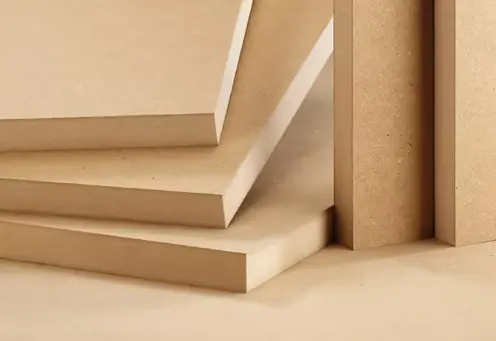
Before we can compare materials, it’s essential to understand what they are. MDF stands for Medium-Density Fiberboard. It’s not one specific kind of wood; rather, it’s an engineered wood product. The process to make MDF is fascinating. We take recycled wood residuals—the leftover chips and shavings from both hardwood or softwood milling operations—and break them down into extremely fine wood fibers. Think of it as turning solid wood into something resembling coarse flour.
These tiny wood fibers are then mixed with glue—specifically, a wax and resin binder like urea-formaldehyde—to create a consistent slurry. This mixture is laid out into a thick mat and subjected to high temperatures and pressure. This process compresses the fibers and cures the resin, forming a dense, flat, and solid mdf panel. The result is an engineered product made from real wood components, but with properties that are often more predictable than natural wood. Unlike a plank of oak, an MDF board has no grain, knots, or voids, which is a huge advantage for specific applications.
How Does the Density of an MDF Board Affect Its Use?
The name itself—Medium-Density Fiberboard—points to its most defining characteristic. The density of a material is a measure of its mass per unit volume. For an MDF board, this density is incredibly uniform throughout the entire mdf sheet, which is something you’ll never find in solid wood. This consistent density is what makes MDF so unique and useful in many woodworking projects.
Here’s a simple breakdown of how its density impacts its performance:
- Weight: MDF is denser and heavier than plywood and most softwoods. A full mdf panel can be quite heavy, which is a consideration for large cabinet doors or long shelves.
- Machinability: Because the density is uniform, MDF is easy to cut and machine with incredible precision. It doesn’t splinter like solid wood, and it can be routed to create smooth, detailed edges for decorative cabinet doors.
- Strength: While it’s very strong and stable in terms of staying flat, it doesn’t have the same structural, load-bearing strength as plywood or solid wood.
- Screw Holding: MDF holds screws very well on its face, but not as well on its edges due to the fibrous structure. Special techniques and hardware are often used for edge connections.
This controlled density is what makes MDF a great material for applications where a smooth surface and stability are more important than raw structural strength.
Are There Different Types of MDF Suitable for a Kitchen Cabinet?
Yes, not all MDF is the same. As a manufacturer, we produce several types of MDF, each engineered for a specific purpose. For a kitchen cabinet, which can be exposed to steam, splashes, and changes in humidity, choosing the right type is critical.
Here are the primary types of MDF you should be aware of:
- Standard MDF: This is the most common and least expensive type. It’s a great all-rounder for dry applications like bookshelves, media centers, and bedroom furniture.
- Moisture-Resistant MDF (MR MDF): This is the go-to option for kitchens and bathrooms. MR MDF is made with a special moisture-repellent resin that significantly reduces how much water the board absorbs. It’s not waterproof, but it can handle the occasional splash and high humidity far better than standard MDF. It is often identifiable by a green dye in the core.
- Fire-Retardant MDF (FR MDF): This specialized panel is used in commercial applications where building codes require fire-rated materials. It has additives that slow the spread of flames.
- Ultralight MDF: This is a lower-density version that is easier to handle. It’s best used for projects where weight is a concern and structural strength is not, such as decorative ceiling panels or trade show displays.
For any kitchen cabinet project, I always recommend using moisture-resistant MDF for all components to ensure longevity.
How Does an MDF Panel Compare to Plywood?
This is a classic debate in woodworking. Both MDF and plywood are excellent building materials, but they excel in different areas, especially when it comes to cabinetry.
Plywood is made by gluing together thin layers of wood veneer, with the grain of each layer running perpendicular to the next. This cross-graining gives plywood superior structural strength and the ability to hold screws very well. It’s also lighter than MDF. For this reason, many high-end cabinet makers prefer to use plywood for the structural box of the cabinet.
However, MDF has a major advantage: its surface. The face of an MDF panel is perfectly flat and smooth, making it a far superior substrate for paint. Plywood has a real wood material grain that can telegraph through paint, and its edges are notoriously ugly, showing the layers of plies. An MDF edge, by contrast, can be machined and finished to look like a solid piece of wood. For this reason, even cabinet makers who use plywood for the boxes will often use MDF for the doors.
Is an MDF Cabinet Cheaper Than Wood? A Full Cost Breakdown.
Absolutely. This is one of the primary reasons MDF has become such a popular choice. The cost of MDF is significantly lower than that of solid wood. An mdf cabinet offers the look and feel of a high-end painted cabinet for a much lower price tag.
Let’s look at a typical material cost breakdown on a per square foot basis. Please note these prices are illustrative and will vary depending on your location and supplier.
| Material Type | Average Cost (Raw Material) | Notes |
|---|---|---|
| Standard MDF Board | $1.50 – $3.00 per square foot | Price depends on thickness. |
| Moisture-Resistant MDF | $2.00 – $4.00 per square foot | The best choice for kitchens. |
| Cabinet-Grade Plywood | $2.50 – $5.00 per square foot | Strong but requires edge finishing. |
| Solid Wood (e.g., Poplar) | $5.00 – $10.00 per square foot | A common, paint-grade hardwood. |
| Expensive Hardwood (e.g., Oak/Maple) | $8.00 – $20.00+ per square foot | Used for high-end, stained cabinetry. |
As you can see, mdf is more affordable from the start. A full sheet of 3/4" MDF board might cost around $50, while a similar-sized sheet of cabinet-grade plywood could be $80, and the equivalent amount of solid maple could be over 300 per sheet. When you scale this up for an entire kitchen, the savings from using MDF are substantial. This is why MDF cheaper options are so attractive for homeowners and builders alike.
What is the Difference Between MDF and Particle Board?
It’s a common mistake to lump MDF and particle board together, but they are very different materials in terms of quality and performance. While both are engineered wood products, the key difference lies in the size of the wood particles used.
MDF is made from wood fibers, which are microscopic. This creates a very dense, tight, and smooth panel. Particle board, on the other hand, is made from larger wood chips, sawdust, and shavings all bonded together with resin. If you look at the edge of particle board, you can clearly see the individual chips.
Because of this, MDF is significantly stronger, denser, and more durable than particle board. It has a much smoother surface for painting and can be machined with precision. Particle board is the least expensive wood panel product, but it is also the weakest and most susceptible to moisture damage. It doesn’t hold screws well and is prone to chipping. While it has its uses in low-cost furniture, MDF board is a far superior material for building a lasting kitchen cabinet.
Why Should You Choose MDF for Your Interior Design?
From an interior design perspective, MDF is a fantastically versatile material. Its most significant advantage is its role as a "blank canvas." Because it has no grain, it provides the perfect substrate for a flawless, uniform paint finish. This is ideal for many popular design styles today:
- Modern & Minimalist: These styles demand clean lines and smooth, unblemished surfaces. MDF is the perfect choice for flat-panel cabinet doors in a high-gloss or matte finish.
- Shaker Style: The classic Shaker cabinet door, with its simple frame-and-panel construction, can be made from one solid piece of MDF. The details can be routed in, eliminating the joints that can crack over time on a solid wood door.
- Custom Colors: MDF allows you to paint your cabinets any color you can imagine. You aren’t limited by the natural tones of wood, giving you complete creative freedom to match your design vision.
The stability of an MDF panel also means that large cabinet doors will stay flat and true, which is essential for maintaining the clean gaps and alignments that modern interior design demands.
What Are the Best Uses of MDF in Cabinet Construction?
Professionals often use a "hybrid" approach to get the best of both worlds. The best use of MDF leverages its strengths while avoiding its weaknesses. For a high-quality kitchen cabinet, a smart builder will often use different materials for different parts of the cabinet.
- Cabinet Doors & Drawer Fronts: This is where MDF truly shines. Its stability and smooth surface make it the ideal material for painted doors. A well-made mdf cabinet door will look spectacular and be more stable than a solid wood door. We offer many decorative mdf board options that are perfect for this.
- Decorative Elements: Any part of the cabinetry that is decorative, such as crown molding, light valances, or applied end panels, is perfect for MDF.
- Cabinet Boxes (Carcasses): This is where there’s debate. Many builders prefer to use plywood for the cabinet boxes because it’s lighter, structurally stronger, and holds screws better, making for a more robust installation. However, a well-constructed MDF box, especially one made from thicker mdf, is perfectly adequate and more cost-effective.
Using MDF for the visible, "show" surfaces and plywood for the hidden, structural boxes is a very common and effective strategy for better building.
How Does MDF Perform in Terms of Durability and Longevity?
This is a key concern for anyone investing in a new kitchen. How does a cabinet made of MDF hold up over time? When properly built and finished, an MDF cabinet can last just as long as a solid wood cabinet.
The single most important factor in the terms of durability and longevity of MDF is the quality of its finish. MDF‘s main enemy is water. A raw, unsealed MDF board will swell and degrade if it gets wet. However, a cabinet that has been properly sealed with a high-quality primer and finished with multiple topcoats of durable paint is incredibly resistant to moisture. The paint creates an impermeable barrier that protects the MDF core.
In some ways, MDF is more durable than solid wood. A solid wood door is made of multiple pieces of wood glued together. Over time, as the wood expands and contracts with changes in humidity, tiny cracks can appear in the paint at these joints. Because an MDF door is one solid piece, this is never an issue. For a painted finish, MDF may be a better, more stable choice in the long run.
So, Is MDF or Hardwood the Right Choice for You?
The decision to choose MDF or hardwood comes down to two things: your desired finish and your budget.
Choose Hardwood if:
- You want a stained finish that showcases the natural beauty and grain of the wood. You simply cannot stain MDF to look like real wood.
- Your budget is flexible, and you value the prestige and tradition of solid wood cabinets.
- You are building heirloom-quality furniture that needs to withstand centuries of use.
Choose MDF if:
- You want a painted finish. MDF is a smooth, stable, and superior surface for paint compared to solid wood.
- You are budget-conscious. MDF provides a high-end look for a fraction of the cost, making it a smart financial choice for any home project.
- You want modern, Shaker, or other styles with precise details and a flawless, uniform color. For this, an MDF board from a reliable factory is the ideal raw material.
For most people planning a kitchen cabinet renovation today, MDF is not just a cheaper alternative; it is often the better material for the job, providing a more stable and perfect base for the popular painted finishes we see in modern interior design.
Key Takeaways for Choosing Your Cabinet Material
- MDF is an Engineered Wood Product: It’s made from wood fibers and resin, creating a dense, stable panel with a perfectly smooth surface ideal for painting.
- Cost is a Major Factor: MDF is significantly cheaper than wood, with raw material costs that can be 50-70% lower than solid hardwood.
- Choose the Right Type: For kitchens and bathrooms, always use Moisture-Resistant (MR) MDF to protect against humidity and moisture.
- MDF Excels for Painted Finishes: Its lack of grain and stability make it a superior choice for any cabinet that will be painted, preventing cracks and providing a flawless surface.
- Hardwood is for Stained Finishes: If you want to see the natural wood grain, hardwood is your only option.
- Durability is in the Finish: A properly sealed and painted MDF cabinet is extremely durable and can easily last for decades, often outperforming solid wood in terms of paint stability.
Post time: 11-07-2025