As a manufacturer of engineered wood products, my name is Allen, and my world revolves around density, resin, and wood fiber. From our factory in China, we engineer and ship millions of square feet of fiberboard to clients like Mark Thompson in the USA. Mark is a sharp businessman who builds high-quality furniture and cabinetry. He needs materials that are consistent, reliable, and cost-effective. He often asks me, "Allen, what’s the real difference between HDF and MDF? When is one a better choice than the other?" It’s a fantastic question. While they may look similar, the subtle differences in their density and composition have a huge impact on their performance and best uses. This guide is for anyone like Mark who wants to look beyond the surface and truly understand these versatile materials to choose the right material for any project.
What is an Engineered Wood Product and How is it Made?
Before we dive into the specifics of MDF vs HDF, it’s important to understand the category they belong to: engineered wood. Unlike solid wood, which is milled directly from a tree log, an engineered wood product is manufactured by binding strands, particles, or wood fiber together with adhesives. The category includes everything from plywood and particle board to the density fiberboard products we’re focusing on today.
The process for making fiberboard is a feat of modern engineering. It starts with hardwood or softwood residuals—the leftovers from other lumber processes. Instead of being wasted, this wood is put into a defibrator, which is a machine that steams and grinds it down into a pulp of fine, individual fibers. This raw wood fiber is then mixed with a wax and a resin binder. This sticky, fibrous mixture is laid out into a thick mat, which is then sent into a massive press. Under high temperature and pressure, the mat is compressed into a solid, dense panel. The amount of pressure and the volume of fiber used in that mat are what determine the final density of the board—and this is what creates the fundamental difference between MDF and HDF.
Decoding Medium Density Fiberboard (MDF): What Are Its Core Properties?
Medium Density Fiberboard, or MDF, is one of the most popular and versatile engineered wood products made today. It’s the go-to material for a vast range of applications, from the construction of furniture and cabinetry to decorative molding and shelves. As its name suggests, the defining characteristic of MDF is its "medium" density, which typically ranges from about 600 to 800 kg/m³ (kilograms per cubic meter).
This specific density gives MDF its unique set of pros and cons. Its biggest advantage is its incredibly smooth surface. Because it’s made from wood fibers that are refined and pressed, there is no grain, knots, or voids, resulting in a uniform surface that is perfect for painting, laminating, or applying veneer. This machinability is a huge plus; you can cut, drill, and route MDF easily without worrying about splintering. However, standard MDF is not known for its moisture resistance and can swell or warp if exposed to water or high humidity. It’s an excellent, affordable alternative to solid wood for many interior applications.
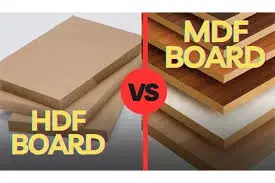
Introducing High Density Fiberboard (HDF): How is it Different from MDF?
Now, let’s turn up the pressure. High-Density Fiberboard (HDF) is the stronger, tougher sibling of MDF. The manufacturing process for HDF and MDF is nearly identical: both are made by breaking down hardwood or softwood into fine wood fiber, mixing it with resin, and pressing it with heat and pressure. The key difference? HDF is made with more wood fiber packed into the same amount of space and compressed under significantly higher pressure.
This results in a product made with a much higher density, typically ranging from 800 to 950 kg/m³. This increase in density gives HDF several distinct advantages over MDF. It is stronger, harder, and significantly more durable. The tightly compressed fiber structure also means HDF offers better moisture resistance compared to standard MDF, although it is still not waterproof. This added toughness and durability, however, comes at a cost. HDF is heavier and generally more expensive than MDF, which is why it’s reserved for more demanding applications.
MDF vs HDF: A Head-to-Head Comparison of Density and Durability
Understanding the differences between MDF and HDF is crucial for making an informed decision. While they are both types of density fiberboard, their properties make them suitable for very different applications. Let’s put them side-by-side to see how they stack up.
| Feature | Medium Density Fiberboard (MDF) | High Density Fiberboard (HDF) |
|---|---|---|
| Density | 600 – 800 kg/m³ | 800 – 950 kg/m³ |
| Strength | Good | Excellent |
| Durability | Moderate | High |
| Moisture Resistance | Low (unless treated) | Good |
| Weight | Heavy | Very Heavy |
| Cost | Affordable | More Expensive |
| Machinability | Excellent, easy to cut and route | Good, but harder on tool blades |
| Best For | Furniture, cabinetry, shelves, molding | Laminate flooring, high-end cabinets, door skins |
As you can see, the primary trade-off is between cost and performance. MDF provides excellent value and versatility for the vast majority of interior furniture and decorative projects. HDF is the premium choice when superior strength, durability, and moisture resistance are non-negotiable.
What About Particle Board? Where Does it Fit in the Density Spectrum?
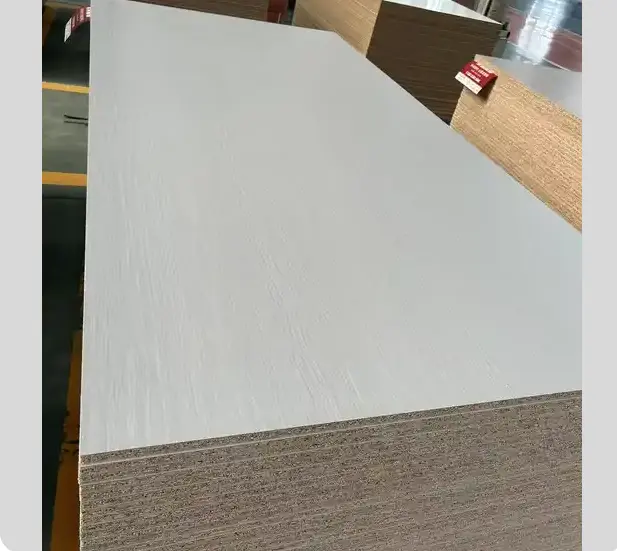
To get a full picture of these composite materials, we have to talk about particle board (also known as chipboard). If HDF is the strongest of the three, particleboard is on the opposite end of the spectrum. It’s an engineered wood material made from wood chips, shavings, and even sawdust, which are all bonded together with resin.
The key difference is the raw material. While MDF and HDF are made from fine, uniform wood fiber, particle board is made from much larger and more irregular particles. This results in a product with a lower density and less structural integrity. The surface of particleboard is not as smooth as MDF, and it’s much more susceptible to absorbing moisture and swelling. Its main advantage is affordability; it is the cheapest of the three fiberboard options. Because of this, particleboard is widely used for budget-friendly furniture pieces, underlayment for countertops where a veneer or laminate will be applied, and in applications where strength is not a primary concern. It doesn’t hold fasteners well and is not suitable for load-bearing structures.
What Are the Best Uses for Medium Density Fiberboard (MDF)?
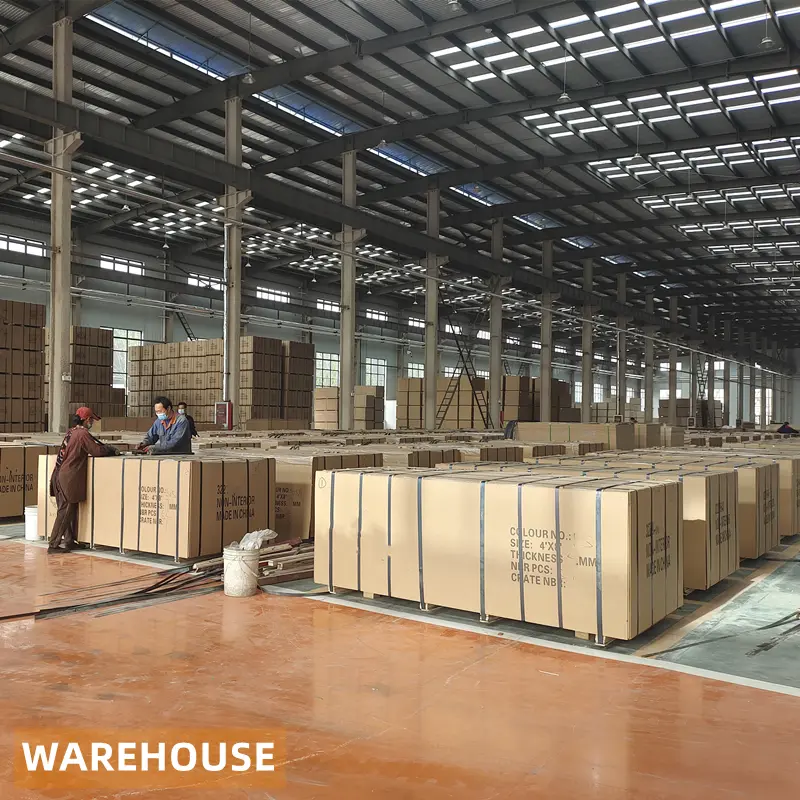
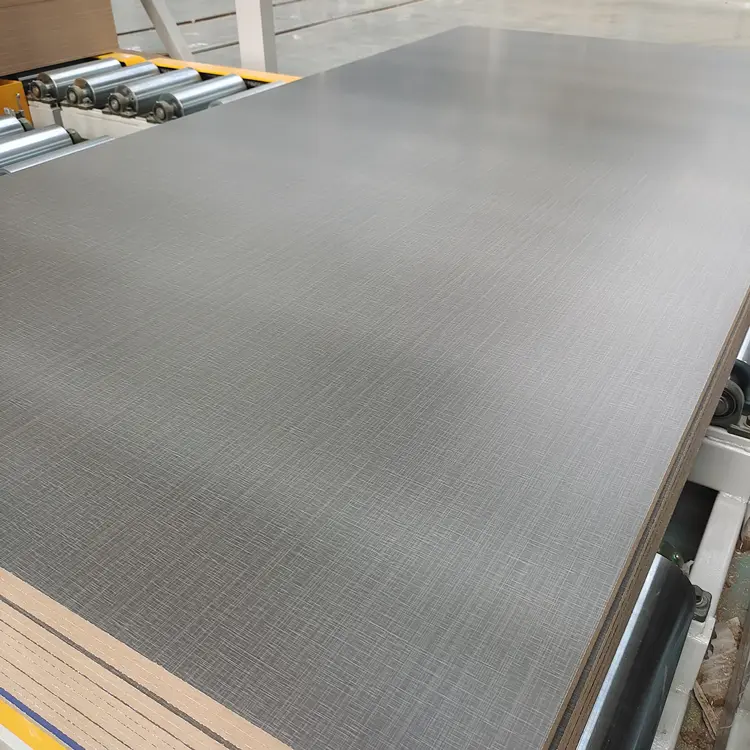
The versatility of MDF is its greatest strength. Its combination of a smooth surface, consistent density, and affordability makes it the ideal material for countless projects. In our factory, we produce vast quantities of Melamine MDF board panel precisely because it’s so popular for these applications.
Here are some of the best uses for MDF:
- Cabinetry: MDF is the industry standard for cabinet doors, especially those that will be painted. Its stability means large doors won’t warp or twist due to changes in humidity, and its perfectly smooth surface provides a far superior base for paint than solid wood or plywood.
- Shelving: For bookshelves and display shelves, MDF offers a strong and stable solution that resists sagging better than particle board.
- Furniture: From desks and dressers to entertainment centers, MDF is used extensively in the construction of furniture. It’s an economical way to create strong, stable furniture pieces with a flawless surface finish.
- Decorative Molding and Trim: The excellent machinability of MDF allows it to be routed and shaped into intricate profiles for baseboards, crown molding, and decorative wall panels.
Essentially, if a project is indoors, won’t be exposed to significant moisture, and requires a smooth, painted finish, MDF is almost always an excellent and cost-effective choice.
When is High Density Fiberboard (HDF) the Superior Choice?
While MDF is the all-rounder, there are specific situations where upgrading to High Density Fiberboard is not just a good idea, but a necessary one. You should choose HDF when your project demands a higher level of performance and durability.
The most common application for HDF is as the core material for laminate flooring. The flooring you walk on every day likely consists of a decorative layer, a wear-resistant coating, and a core of HDF. Its high density and hardness provide excellent impact resistance (protecting against dropped objects) and the necessary structural integrity for the interlocking click-and-lock systems. Its better moisture resistance also helps protect the floor from minor spills.
Other best uses for HDF include:
- High-End Cabinetry: For premium kitchens or bathroom vanities where humidity is a concern, HDF doors provide extra stability and durability.
- Door Skins: The thin but tough surface layer on many interior doors is made from HDF.
- High-Traffic Commercial Fixtures: Store fixtures and displays that need to withstand daily abuse are often used with HDF.
- Substrates for Veneers: In high-end furniture, HDF is sometimes used as a substrate for a thin layer of real wood veneer, providing a more stable base than MDF.
MDF vs Plywood: Understanding the Key Differences and Uses
Another frequent comparison is MDF vs Plywood. While both are engineered wood panels, their internal structure is completely different, which gives them distinct pros and cons. Plywood is made by gluing together thin layers of wood veneer, with the grain of each layer running perpendicular to the one before it. This cross-grain construction gives plywood exceptional strength and makes it less likely to split.
The primary advantage of plywood is its strength-to-weight ratio. It’s stronger than MDF and holds screws more tenaciously, making it a better choice for structural applications like subflooring, roof sheathing, and cabinet boxes that need to bear heavy loads. However, the surface of plywood has a natural wood grain, and its edges can have voids and are not smooth, making it more difficult to achieve a flawless painted finish.
This is where MDF shines. For decorative applications where a perfectly smooth finish is paramount—like painted cabinet doors or furniture panels—the uniform fiber composition of MDF is superior. MDF is also more stable and less likely to warp or expand and contract compared to solid wood or plywood. In short, choose plywood for strength and structural needs, and choose MDF for a superior surface finish and decorative applications.
How Does the Manufacturing Process Impact the Final Fiberboard Product?
As a manufacturer, I can tell you that the final quality of an MDF or HDF panel is determined long before it comes out of the press. The specific type of wood fiber used (hardwood or softwood), the quality and type of resin, and the precise control of the pressing cycle all have a massive impact.
One of the biggest concerns for buyers like Mark is formaldehyde emissions. The resin used to bond the fibers together traditionally contained urea-formaldehyde. Today, reputable manufacturers like us use low-emission or no-added-formaldehyde (NAUF) resins to meet strict international standards like CARB P2 (California Air Resources Board) and European E1/E0 standards. Ensuring your supplier can provide certification for these standards is crucial for safety and regulatory compliance.
Furthermore, we can engineer fiberboard for specific properties. By changing the resin to a moisture-resistant formula, we can create MR MDF for use in humid environments. By adding specific chemicals, we can produce fire-retardant MDF. The ability to control these inputs is what makes engineered wood so versatile and allows us to create a wide range of products like our Custom Raw Plain MDF Board tailored for different applications.
Making the Right Choice: MDF or HDF for Your Application?
So, how do you decide between MDF and HDF? It really comes down to answering three key questions about your project:
- What is the application? Is it a decorative item like crown molding, or a functional piece like a floor? For most furniture and decorative uses, MDF is perfectly sufficient. For applications that require high impact resistance and durability, like laminate flooring or commercial fixtures, HDF is the way to go.
- Will it be exposed to moisture? For a dry environment like a bedroom or living room, standard MDF is fine. For a kitchen, bathroom, or laundry room, you should strongly consider moisture-resistant MDF or upgrade to the denser, more resistant HDF.
- What is your budget? MDF is significantly more budget-friendly than HDF. It’s important to weigh the added cost of HDF against its performance benefits. For many projects, the superior strength of HDF is simply overkill, and the money saved by using MDF can be allocated elsewhere.
By carefully considering these factors, you can confidently select the right density fiberboard for your needs, ensuring your project has the perfect balance of performance, durability, and affordability. Many of our clients find that our High Quality Wood Grain Melamine MDF provides a perfect middle ground, offering the ease of MDF with a durable, pre-applied finish.
Post time: 10-30-2025