Are you confused by the endless material options like particle board, MDF and OSB, or standard plywood? Selecting the right board for your projects doesn’t have to be a guessing game. From choosing the correct glue to understanding formaldehyde emission, this guide covers everything. We will explore E1 and E2 grade materials, melamine applications, and strict formaldehyde emission standards. Whether you are applying a decorative laminate or building heavy-duty furniture, reading this article will equip you with the exact knowledge needed to select a safe, E2 compliant, or ultra-low gas emitting particle or grade specific material for your next major build.
What Are the Key Differences Between Particle Board, Plywood, and MDF?
When you walk into a manufacturing facility, you will see massive stacks of raw materials. The three kings of the industry are particle board, plywood, and MDF. Each board has a very specific job. A smart procurement director knows exactly when to use each one instead of expensive solid wood.
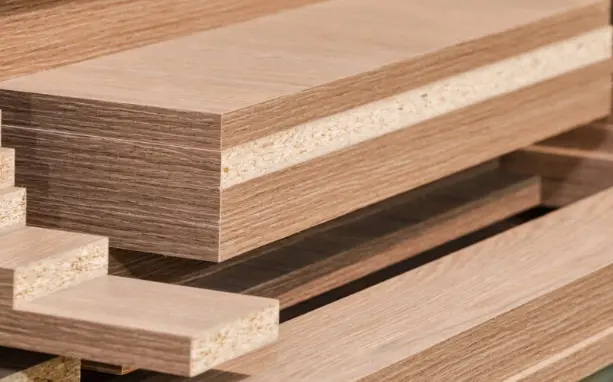
Particle board is made from small wood chips, sawdust, and liquid resin. It is an inexpensive option. It is a highly versatile material that works great for the hidden inner boxes of a cabinet. However, its coarse inner particle structure means it doesn’t hold screws as strongly as other options. It is not always suitable for applications requiring immense weight-bearing capacity.
On the other hand, plywood uses thin layers of real wood veneer. These layers form a strong ply. This gives it incredible strength and stability. MDF, or medium density fiberboard, uses microscopic wood fibers pressed together. Because it is much denser, it provides a perfectly smooth surface. If you are building a painted desk, MDF is usually your best bet.
How Does the Manufacturing Process Impact a Board and Its Usage?
The manufacturing process completely determines how a material performs. Factories take raw materials and use a specific type of adhesive to bind them. They add heat and immense pressure. This transforms loose scraps, like a small wood flake, into a solid panel.
During manufacturing, factories might add wax to help repel water. They also sand the surfaces until they are perfectly smooth. This makes the panel ready for a beautiful laminate or a natural veneer finish. Understanding this process helps you define the best usage for each product. For instance, particle board manufacturers will tell you their product is perfect for lightweight shelves but terrible for heavy structural beams. It is also important to note that oriented strand board uses a similar process but with much larger wood flakes.
"Choosing the correct core material dictates 90% of the product’s lifespan." – Industry Expert
Let’s look at a quick comparison: A standard board made for structural use will have a different glue ratio than a board made for decorative use.
What Does E2 Mean When Discussing Formaldehyde Emission Standards?
Safety is a huge priority when building modern interiors. You have probably heard about VOCs and chemicals in building materials. When we talk about formaldehyde emission standards, we are measuring how much gas escapes from the board into the air.
The E2 designation refers to a specific European standard. An E2 certified board contains a higher emission level than E1 or E0. Today, many countries have updated their building codes. While E2 was once very common, many builders now look for lower emission options for enclosed spaces.
If you are using an E2 product, it is extremely important to seal it properly. By applying a solid melamine surface and thick edge banding, you trap the gas inside. This prevents the material from continuing to give off formaldehyde into the room. A well-sealed core minimizes risks and ensures a safer space.
How Do E1 and E2 Grade Compare for Indoor Furniture?
When building pieces for a home or office, you must consider air quality. The grade of your core material directly impacts the environment of a room. For indoor furniture, you generally want the lowest emissions possible.
An E1 board releases significantly less gas than an E2 board. It is currently the standard for safe indoor use in many regions. If you are constructing a kitchen or a bedroom set, choosing E1 is a smart, responsible decision.
That does not mean E2 is useless. It has a very low cost, making it appealing for certain projects. However, it is better suited for well-ventilated areas or temporary installations like event packaging crates. For premium high quality wood grain melamine chipboard, we always recommend adhering to strict emission guidelines to ensure the safety of your end consumer. A good board will elevate your furniture to the next level.
Why is Plywood Considered a Highly Durable Engineered Wood Product?
Among all the options, plywood stands out as an incredibly tough engineered wood product. Instead of gluing dust or chips together, it uses actual sheets of timber. By crossing the grain of each layer, it achieves amazing durability.
This cross-graining technique gives the board incredible stability. It resists twisting and warping much better than a standard chipboard. If you need a material that can support heavy loads, this is your answer. You can use it alongside solid wood for premium builds.
Because of its strength, it is widely used for sub-floors. A solid floor needs to carry the weight of people and heavy items without sagging. While it is more expensive than other cores, the investment pays off in longevity.
What Role Does the Manufacturer Play in Reducing Formaldehyde?
The manufacturer holds the key to safety. They decide what kind of glue goes into the mix. Traditional factories used cheap urea-formaldehyde resins. These resins are strong and have a low price, but they have high emissions.
Today, a responsible supplier uses advanced adhesives. They might use synthetic resins that drastically cut down the amount of gas released. Some even use formaldehyde-based alternatives that cure differently, locking the chemicals deep inside the core. A good glue formulation makes a huge difference.
By upgrading their chemistry, a factory can produce safer materials. This protects both the factory workers and the final consumer. When sourcing materials, always ask your partner about their specific adhesive formulas used in their furniture board production.
How Do Particle and MDF Boards Behave When Exposed to Moisture?
Water is the natural enemy of most engineered cores. If you expose a standard particle core to water, it acts like a sponge. It will absorb the liquid rapidly. This causes the edges to swell and crumble.
MDF reacts similarly. Because it is a density fiberboard, the tiny fibers drink up water fast. If you place it in a very humid room without proper sealing, it will eventually fail. You must protect it from high humidity.
To combat this, builders use special moisture resistant panels. Every board is infused with special resins and wax. While they are not waterproof, they give you much more time to wipe up spills. You can find excellent melamine mdf board panels that feature specialized edges to keep dampness out. This makes them highly resistant to daily wear.
Is an NAF Rating Better Than Standard Formaldehyde Emission Levels?
In recent years, the market has pushed for even greener options. You might see the term NAF. This stands for No Added VOCs. A board with this rating uses a completely different type of binder, often soy-based or a special phenolic resin.
When it comes to air quality, this alternative is the gold standard. It produces levels so low they barely register on testing equipment. This makes it the safest possible choice for homes, hospitals, and schools.
While these products are more expensive than an E1 or E2 board, they offer immense peace of mind. For high-end builders, offering a certified product is a massive selling point in modern indoor decoration.
Can Wood Products Like Plywood Release Formaldehyde Over Time?
Yes, they can. Most wood products will slowly release formaldehyde over their lifespan. However, the rate of off-gassing drops significantly after the first few months.
Even natural wood and solid hardwood naturally contain trace amounts of this chemical. It is part of the tree’s biology. The concern only arises with the concentrated industrial glues used in older composite materials like standard particleboard or a low-end fiberboard.
If you are worried about your new desk emitting formaldehyde over time, proper ventilation is key. Keep your windows open for the first few weeks. Also, ensure all raw edges are sealed. Applying a thick edge band stops the gas from escaping freely. For those looking for sturdy alternatives, our factory provide melamine plywood 12mm is tightly sealed and tested for safety.
How to Choose the Right Board for Your Commercial Manufacturing Needs?
Selecting the perfect material for your manufacturing line requires careful thought. You have to balance cost, performance, and safety. A thick board is not always better; it depends on the thickness required for the specific joint.
First, consider the physical demands. Does the piece need to be highly structurally sound? If so, lean towards a thicker plywood. Are you applying a very thin laminate? Then you need the glass-like surface of an MDF or a medium-density board.
Next, look at the legal requirements of your target market. If you are shipping to strict regions, you must meet exact standards. If you need a simple custom raw plain MDF board for non-structural interior decoration like wall panels, make sure it fits your budget. Using the right glue and the right grade of board will ensure your furniture lasts for generations.
Summary
- Choosing the correct board is vital for long-lasting furniture.
- Particle board and plywood serve different structural needs based on the glue and resin used.
- Always verify the emission level to ensure a safe environment.
- An E2 board requires proper sealing with melamine or a veneer.
- Consult your supplier about the exact grade of panel required for your specific manufacturing needs.
Post time: 06-30-2026