There is an undeniable warmth and sophistication that American Black Walnut brings to a room. It is a wood species that has defined premium furniture and interior design for centuries. However, working with solid walnut presents challenges: it is expensive, heavy, and prone to warping with humidity changes. This is where walnut veneered MDF changes the game for manufacturers and designers alike. By marrying the exquisite, natural beauty of wood veneers with the engineering stability of a medium-density fiberboard core, we create a material that offers the best of both worlds. For professionals sourcing materials for high-end cabinetry or architectural millwork, understanding the nuances of this product—from the crown cut figure to the stability of the MDF core—is essential for delivering quality without compromising on profit margins.
Why Walnut Veneer on an MDF Core is Superior to Solid Wood
When we talk about walnut veneered MDF, we are describing a composite panel that features a thin layer of real hardwood sliced from a log, bonded to a substrate. While solid wood is traditional, it comes with inherent risks. Natural wood breathes; it expands and contracts, which can lead to cracks or twisting in large furniture pieces.
An MDF core solves this. Medium density fiberboard is an engineered product known for its isotropic properties—it has no grain direction, meaning it is incredibly stable and uniform. When you apply a walnut veneer to this smooth and stable surface, you get a panel that looks exactly like solid timber but behaves much better. It stays flat. For a cabinet door or a large conference table, this stability is non-negotiable. Furthermore, using veneer sheets allows us to stretch a single beautiful log much further, making it a more sustainable and cost-effective choice than solid lumber.
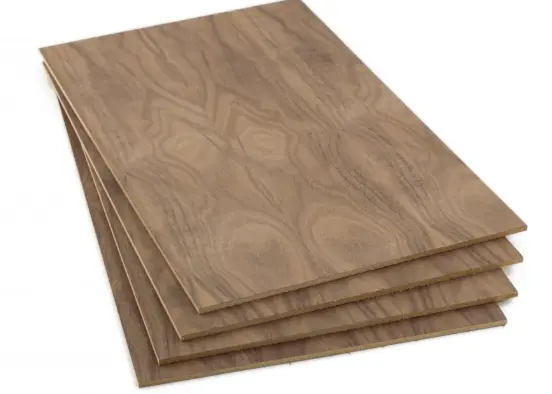
How Does the Crown Cut Affect the Grain Pattern of the Sheet?
The visual impact of a veneer depends heavily on how the wood is sliced from the log. In the world of black walnut, the crown cut is arguably the most sought-after aesthetic. This cutting method involves slicing across the growth rings, which produces a distinctive "cathedral" or arched grain pattern.
Why is this important? Because crown cut walnut veneer showcases the natural, wild beauty of the tree. It provides that classic, timber-like appearance that clients love. If you were to look at a quarter cut veneer, you would see straight, uniform lines. While that has its place, the crown cut offers more character and variation, making each sheet feel unique. When these sheets are book-matched (where every other leaf is turned over like the pages of a book), the resulting symmetrical pattern can be absolutely stunning across a set of cabinet doors.
Why Choose Black Walnut Veneer for High-End Furniture Making?
Black walnut (Juglans Nigra) is distinct from its European counterpart. It tends to be darker, with rich chocolate and coffee tones, sometimes streaked with purples or lighter sapwood. In furniture making, this wood creates an immediate sense of luxury.
Using black walnut veneered MDF allows manufacturers to produce furniture that looks substantial and expensive but is lighter and easier to ship than solid wood. Whether it is a sleek, modern credenza or a traditional wardrobe, the aesthetic of black walnut fits perfectly. It adds warmth to modern minimalist designs and depth to classic interiors. Because the veneer is real wood, it can be finished with oils, lacquers, or stains just like solid lumber, allowing for a custom level of sheen that enhances the natural beauty of the grain.
Is Walnut Veneered MDF More Affordable Than Veneer Plywood?
Cost is always a factor in manufacturing. Generally, MDF is more affordable than a plywood core. While veneer plywood is lighter and stronger structurally for certain load-bearing applications, MDF offers a distinct advantage for veneer application: surface quality.
Plywood is made of layers, and sometimes the texture of the inner plies can "telegraph" through a thin veneer, creating a bumpy surface. Standard MDF has a perfectly homogenous, high-density surface. This smooth MDF face ensures that the thin layer of walnut veneer bonds perfectly flat. This means less sanding and finishing work is required to get a glass-like surface. So, not only are veneered MDF sheets offer a better price point on the raw material, but they often reduce labor costs in the finishing booth.
What Are the Primary Decorative Applications for These Panels?
The versatility of walnut veneered MDF is vast. Because it is available in various thicknesses and sizes, it can be adapted to almost any interior project.
- Cabinetry: Kitchens and wardrobes are the most common uses. The stability of the MDF prevents doors from warping.
- Wall Panels: Large format sheets (often 4′ x 8′ or larger) are used to create stunning feature walls in hotels and corporate offices.
- Office Furniture: Desks and conference tables benefit from the smooth writing surface that MDF provides.
- Panel Mouldings: Strips can be cut to create intricate detailing.
For projects requiring a specific look, you can even find Custom Raw Plain MDF Board 0.8mm-25mm that serves as the perfect substrate for custom pressing operations if you prefer to lay the veneer yourself.
How Does Walnut Compare to Oak, Maple, and Cherry Veneers?
While walnut is a premium choice, how does it stack up against other popular wood veneers like oak, maple, and cherry?
- Oak: Typically has a very strong, open grain. It is classic but can look busy. Oak is often stained, whereas walnut is usually left natural.
- Maple: A very light, creamy wood. It is harder than walnut but lacks the dramatic color contrast. Maple is often used for interiors of cabinets where a bright look is needed.
- Cherry: Starts pinkish and darkens to a deep reddish-brown with age. It has a tighter grain than oak but is softer than hardwood maple.
Walnut stands out because of its naturally dark colour and sophisticated grain. It doesn’t need to be stained to look expensive. It is the go-to choice when a designer wants to make a bold, elegant statement.
What Sizes and Thicknesses Are Available in Various Markets?
As a manufacturer, we cater to global dimensions. The standard sheet size is 4′ x 8′ (1220mm x 2440mm), also referred to as 48 inches wide. However, larger sizes are available for specialized decorative applications.
Regarding thickness, the range is extensive:
- 3mm: Used for drawer bottoms, cabinet backs, or door skins.
- 6mm: Ideal for wall paneling or lighter cabinet doors.
- 18mm – 19mm: The industry standard for carcass construction, shelves, and doors.
- 25mm+: Used for thick tabletops or heavy-duty architectural elements.
We can also provide specific substrates like New Color Melamine plywood 15mm for Furniture Cabinet Kitchen if a project requires the screw-holding power of a veneer core rather than fiberboard.
How Do You Ensure a Perfect Edge When Working with Veneered Sheets?
One of the tell-tale signs of veneer work is the edge. If you see the raw MDF core, the illusion of solid wood is broken. Professional woodworking requires precise edge banding.
You can use real walnut wood veneer edging, which comes in rolls (either pre-glued or for machine application). For a truly seamless look, you can use solid walnut strips (lipping) glued to the edge of the MDF before the face veneer is applied. This allows you to shape a profile on the edge without exposing the core. In high-volume production, matching PVC or ABS edge banding is also an option, but for high-quality walnut veneer projects, real wood banding is the standard to maintain the premium feel.
Why is the Smooth Surface of MDF Ideal for Veneer Application?
The quality of the bond between the veneer and the substrate is critical. MDF is manufactured by compressing fibers with glue at high pressure. This results in a density that is uniform throughout the thickness of the board.
Unlike plywood, which might have voids or overlapping inner cores that create high spots, MDF is perfectly flat. This means that when the thin veneer is pressed onto the surface, it bonds 100%. There are no air pockets and no "telegraphing" of imperfections from below. This smooth foundation allows for a perfect finish, whether you are applying a high-gloss lacquer or a matte oil. It makes the walnut veneer look its absolute best.

What Should You Look for When Sourcing High-Quality Walnut Veneer?
Sourcing is everything. A high-quality panel starts with a high-quality log. When inspecting walnut veneered mdf, look for consistency in the grain.
- Grade: Veneers are graded (e.g., A, AA). Higher grades have fewer knots and cleaner pattern consistency.
- Splicing: Check how the individual leaves of veneer are joined. The line should be tight and barely visible.
- Adhesion: Ensure there are no bubbles or delamination at the edge of the sheet.
At our facility, we implement strict quality controls to ensure every sheet meets these standards. We understand that a single defect can ruin a piece of furniture. We also offer alternatives like Factory wholesale cheap price High Quality 3mm 10mm 15mm 16mm 17mm 18mm melamine mdf board For Furniture cabinet door which mimic wood grains for more budget-conscious projects, but for the real wood feel, nothing beats our genuine walnut.
Key Takeaways
- Walnut Veneered MDF combines the beauty of natural wood with the stability of MDF.
- Crown cut veneers offer a traditional, luxurious "cathedral" grain pattern that clients love.
- The smooth surface of the MDF core ensures a flawless bond and finish, superior to many plywoods.
- Black walnut offers a sophisticated, darker colour palette suitable for premium interior design.
- These panels are versatile, used in everything from cabinetry to architectural wall panels.
- Available in standard 4′ x 8′ sizes and various thicknesses like 18mm to suit different needs.
- Proper edge banding is crucial to creating a convincing solid-wood look.
Post time: 12-25-2025